Understanding the Basics – What Teachers Need to Know About AI
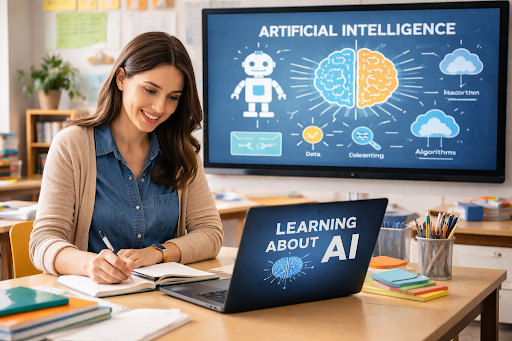
In our last post, we made the case that all K–12 educators—not just STEM teachers—need a foundational understanding of artificial intelligence (AI). The next question is a practical one: what exactly do teachers need to know about AI—and how can they learn it without a tech degree, hours of training, or a background in programming?
This post is designed to demystify AI for educators at any grade level or subject area. Whether you teach third-grade reading, counsel high school students, or lead curriculum at the district level, this guide highlights the core ideas, tools, and classroom connections that make AI approachable, relevant, and teachable.
Let’s start with the basics.
🤖 What Is Artificial Intelligence?
At its simplest, artificial intelligence refers to systems designed to mimic aspects of human intelligence—learning from data, recognizing patterns, and making predictions or decisions.
Chances are, you and your students already use AI every day:
- Recommendation systems on Netflix or YouTube
- Translation tools and voice assistants like Siri or Alexa
- Spell check and grammar suggestions in writing tools
- Generative AI tools such as ChatGPT
You do not need to be a computer scientist to understand these systems—or to help students question how they work and use them responsibly.
🧠 Five Core AI Concepts Every Teacher Should Know
Teaching AI does not require coding or complex math. A clear, conceptual understanding of a few key ideas goes a long way.
- Data
AI systems learn from data, not from human-written rules. The quality and variety of that data matters.
Classroom connection: Use sorting activities with blocks, images, or vocabulary cards to model how training data works. - Algorithms
An algorithm is a set of step-by-step instructions a computer follows to solve a problem. In AI, algorithms help systems learn patterns from data.
Classroom connection: Ask students to write instructions for brushing teeth or making a sandwich to illustrate logical sequencing. - Machine Learning
Machine learning is a type of AI where systems improve by learning from examples rather than explicit instructions.
Classroom connection: Play a guessing game where students adjust their strategy based on feedback, similar to “20 Questions.” - Classification
One of the most common AI tasks—grouping information based on shared features (such as spam versus not spam).
Classroom connection: Use Google Teachable Machine to train a simple model that recognizes gestures or images. - Bias
If training data is biased or incomplete, AI systems can produce biased outcomes.
Classroom connection: Discuss what might happen if a facial recognition system is trained using images from only one demographic group.
🧰 AI Tools Teachers Can Explore—No Coding Required
You do not need special equipment or advanced skills to begin exploring AI. Many free, browser-based tools are designed specifically for educators and students.
- Google Teachable Machine – Train AI models using images, sounds, or poses (Grades 3–12)
- Scratch with ML extensions – Create interactive stories and games (Grades 3–9)
- Code.org AI for Oceans – Learn about data and bias through gameplay (Grades 2–8)
- MIT App Inventor with AI extensions – Build simple apps using drag-and-drop blocks (Grades 6–12)
- Chatbots like ChatGPT – Explore writing support, analysis, and conversational AI (Grades 6–12)
Most of these tools work on Chromebooks or tablets and can be integrated across subject areas.
🧩 Connecting AI to What You Already Teach
AI does not need to live in a standalone course. It fits naturally into existing curriculum.
English Language Arts
- Analyze an AI-generated poem for voice and coherence
- Debate ethical use of AI writing tools
- Write stories from the perspective of an AI system
Social Studies
- Examine AI’s role in surveillance, misinformation, or labor
- Explore historical parallels with automation
- Debate whether governments should use AI in decision-making
Art and Media
- Compare student-created and AI-generated artwork
- Discuss authorship, creativity, and deepfakes
- Analyze AI’s role in pop culture and media
Math and Science
- Use statistics to explore prediction and probability
- Analyze datasets and practice visualization
- Study real-world applications such as AI in medicine or climate science
🤔 Common Teacher Questions—Answered Simply
Do I need to know how to code?
No. Focus on concepts and applications. Many tools are built for non-programmers.
What if I get something wrong?
That is part of the learning process. Teaching AI is an opportunity to model curiosity and growth alongside students.
What is age-appropriate?
Young learners can explore patterns and sorting. Older students can engage in ethics, data analysis, and design challenges.
Is AI safe to use in classrooms?
Yes, when using education-focused tools and clear guidelines. Avoid sharing personal data and explicitly teach AI safety and bias.
🧭 How Teachers Can Start Learning AI Today
- Read or watch something short
Try beginner-friendly resources like Elements of AI, CrashCourse, or MIT explainers. - Try one hands-on tool
Spend 10 minutes experimenting with Google Teachable Machine using images or sounds. - Talk with students
Ask where they encounter AI in their daily lives and how it shapes their experiences. - Collaborate with peers
Start a small “AI curiosity circle” to explore tools and questions together. - Explore free professional learning
Programs like ISTE AI Explorations or Code.org’s AI curriculum offer accessible entry points.
🧠 Reframing the Teacher’s Role in the Age of AI
Teachers do not need to compete with AI. Instead, they teach what AI cannot:
- Empathy and ethical reasoning
- Social and cultural context
- Cross-disciplinary thinking
- Creativity, curiosity, and joy
Understanding AI equips educators to guide students in using it thoughtfully—as a tool, not a replacement for human insight.
📝 Final Thoughts: AI Literacy Starts With Curiosity
Teaching AI does not begin with perfect knowledge. It begins with a willingness to explore. By understanding a few foundational concepts and recognizing how AI already shows up in daily life, educators can take meaningful first steps toward AI literacy.
AI is not just a topic for the future. It is part of today’s classrooms. And every teacher deserves the opportunity to understand it—regardless of grade level, subject area, or technical background.