Inclusive and Culturally Responsive Pedagogy in AI Education at Rex K–12
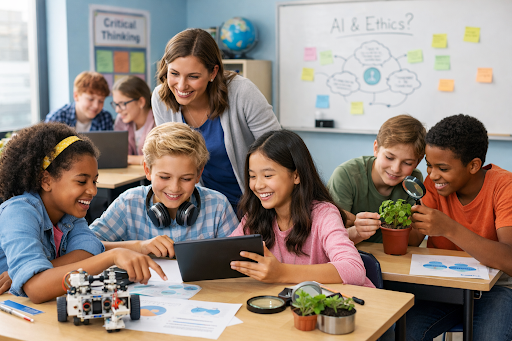
As artificial intelligence (AI) continues reshaping our world, the question for educators is not only “How do we teach AI?” but also “Who gets access to AI learning, and how do we ensure every learner sees themselves in it?” At Rex K–12, we believe equity in AI education isn’t optional. It’s fundamental.
In this final entry of our pedagogy series, we explore how inclusive and culturally responsive practices shape every aspect of our AI curriculum and how we empower all students—regardless of background, identity, or access—to become ethical, creative, and confident participants in an AI-driven future.
Why Inclusion and Cultural Relevance Matter in AI Education
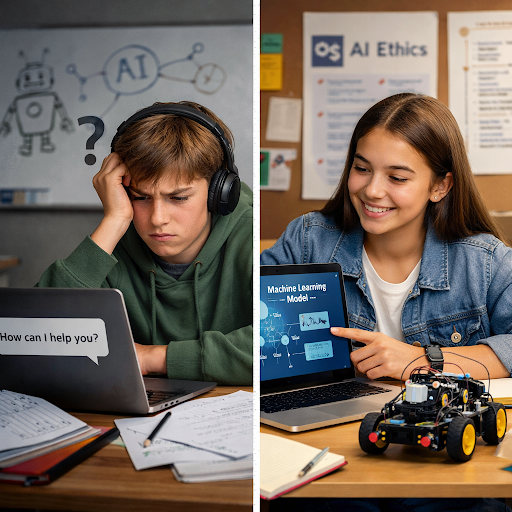
AI education extends beyond algorithms; it shapes representation and opportunity. Historically, the tech sector has underrepresented women, students of color, rural learners, and students with disabilities. These gaps often begin early, with unequal access to relevant and meaningful content.
Without inclusive pedagogy:
- Marginalized students may not see AI as “for them”
- Learning materials can reinforce stereotypes
- One-size-fits-all instruction can exclude diverse learners
- Ethical discussions may ignore how AI affects different communities
At Rex K–12, we address these challenges by designing curriculum intentionally for all learners.
What Is Culturally Responsive Pedagogy?
Dr. Gloria Ladson-Billings defines culturally responsive pedagogy (CRP) as an approach that:
- Recognizes and values students’ cultural backgrounds
- Uses those backgrounds as assets in learning
- Builds academic rigor, critical thinking, and identity affirmation
At Rex K–12, we extend CRP to meet the needs of AI education by integrating Universal Design for Learning (UDL), digital equity frameworks, and critical pedagogy of technology. Together, these ensure students feel seen, heard, and capable of shaping the future of AI.
Rex K–12’s Framework for Inclusive and Responsive AI Pedagogy
We use five core strategies to make our AI instruction inclusive and culturally sustaining.
1. Representation Matters: Diverse Voices in AI
We center a wide range of identities in the stories and examples we highlight.
Examples include:
- Featuring AI leaders like Timnit Gebru, Joy Buolamwini, and Ramesh Raskar
- Exploring community-focused AI problems rather than only mainstream tech examples
- Encouraging students to investigate AI impacts on issues present in their own communities
Why it works: Students engage more deeply when they recognize themselves in the content.
2. Culturally Relevant Curriculum Content
We design learning experiences rooted in students’ everyday lives, identities, and concerns.
Examples include:
- Middle school debates about AI and school safety using local context
- High school discussions about how facial recognition affects people who look like them
- Elementary activities where students model AI using cultural foods, games, or traditions
Why it works: Students connect meaningfully to the content, not just the skills.
3. Multilingual and Multimodal Access
Our curriculum supports all types of learners, including multilingual students, neurodiverse students, and students with disabilities.
Strategies include:
- Vocabulary cards with visuals and audio
- Interactive simulations with drag-and-drop features
- Paper-based templates for low- or no-internet settings
- Bilingual instructions and captioned videos
Why it works: Barriers are removed and diverse learning styles are honored.
4. Critical Consciousness and Ethical Inquiry
Students learn not only how AI functions but how it impacts people differently across communities.
Examples include:
- Exploring bias in criminal justice algorithms
- Writing reflections on AI in housing or immigration decisions
- Studying why AI assistants may misunderstand certain dialects or accents
Why it works: Students build ethical reasoning, civic awareness, and digital literacy.
5. Student Voice, Choice, and Agency
We give students ownership of their AI learning journey.
This includes:
- Choice in project topics and formats
- Flexibility to use low-code, no-code, or unplugged options
- Student-led discussions and feedback cycles
- Capstone projects that reflect personal identity and values
Why it works: Students feel empowered and confident in their learning.
Sample Inclusive Lesson: Grade 7 – “Train Your Own Translator”
Overview:
Students use Teachable Machine or a paper-based simulation to build a translation model using words from their home languages or dialects.
Objectives:
- Understand how AI models learn from data
- Identify gaps in training data
- Recognize the importance of linguistic diversity in AI
Assessment:
- A brief presentation on how their model could serve their community
- A reflection on how it felt to integrate their language or dialect into an AI project
Pedagogical Outcome:
Students’ cultural identities are validated while they develop critical technical and ethical skills.
Inclusive Assessment Practices
Our AI assessments are designed to be:
- Flexible — Students can show mastery through oral explanations, visuals, written work, or coded prototypes
- Supportive — Rubrics are shared in advance and translated if necessary
- Growth-oriented — Students reflect on progress, not perfection
- Collaborative — Peer and self-feedback tools are built into lessons
- Transparent — Expectations are co-created and revisited regularly
Below is a simple descriptive version of the rubric you used previously, now without a table:
- Technical Understanding: Students are evaluated on how clearly and accurately they explain their AI model. Higher performance reflects strong, logical explanations, while lower performance reflects unclear or incomplete understanding.
- Cultural Relevance: Projects are assessed based on how well students connect their AI work to their identity or community. Strong projects make deep, meaningful connections; emerging ones may show only partial relevance.
- Equity and Ethics: Students are evaluated on their ability to identify fairness concerns, potential harms, and ethical trade-offs. Strong performance demonstrates thoughtful analysis; lower levels show limited or missing ethical reasoning.
- Communication: Students are assessed on clarity, organization, and accessibility of their presentation or project. Higher performance reflects confident and well-structured communication.
Supporting Teachers to Teach Inclusively
We support teachers through:
- Curriculum guides that embed inclusive practices
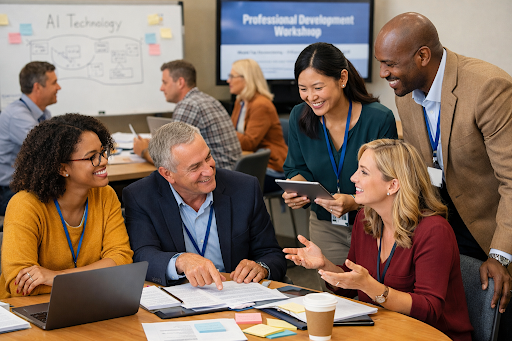
- PD workshops focused on UDL, anti-bias approaches, and AI equity
- Checklists that help teachers use inclusive language
- Model lessons and real student exemplars
- Tools that support ethical conversations and student well-being
We also co-design curriculum with educators from rural, urban, tribal, and multilingual communities to ensure true representation.
Tools We Use for Equity and Inclusion
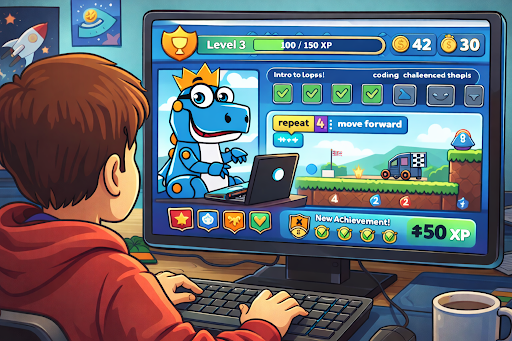
- Scratch: A block-based platform that supports visual learning and storytelling, making coding accessible for younger students and multilingual learners.
- Teachable Machine: A tool that allows students to train models using images, gestures, or sounds, making AI creation hands-on and relatable.
- Canva: A multimodal project tool that helps students express learning through visuals, slides, posters, or infographics.
- Google Forms and Docs: Useful for collaborative writing in students’ preferred languages and for accessible data collection.
- Kialo Edu: A platform that supports structured ethical discussions, helping students explore multiple viewpoints in a guided way.
We supplement these with offline kits and unplugged lessons so AI learning is possible even without consistent technology access.
Final Thoughts: Equity as a Pedagogical Imperative
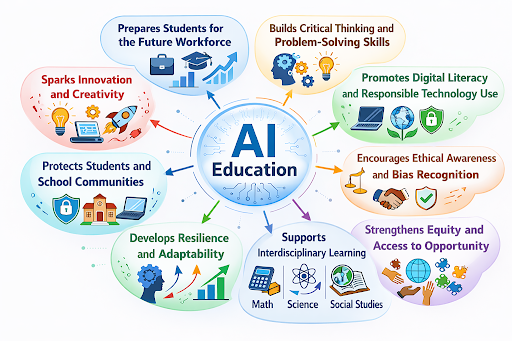
At Rex K–12, equity and inclusion are not add-ons—they are the foundation of our pedagogy. When we teach AI, we are helping students understand how systems work, how the world sees them, and how they can create change.
By embedding culturally responsive and inclusive practices into every lesson, we send a powerful message to every learner: AI is for you. Your story matters. You belong in this future.
The next generation of AI innovators must be not only technically skilled but ethically grounded, socially aware, and critically engaged. Inclusive pedagogy makes that possible—and ensures every student has the opportunity to shape the world they will inherit.