What AI Literacy Actually Means in K–12 (And Why It’s Not Just Prompting)
Artificial Intelligence is quickly becoming part of everyday life for students. From search engines and recommendation systems to AI chatbots and image generators, today’s learners are interacting with AI long before they enter the workforce. Because of this, many schools are asking an important question: What does AI literacy actually mean for K–12 students?
Too often, AI literacy is reduced to one simple skill: prompting. While learning how to communicate effectively with AI tools is valuable, true AI literacy goes far beyond writing a good prompt into a chatbot.
AI literacy is about helping students understand how AI works, how it impacts society, how to use it responsibly, and how to think critically in a world increasingly shaped by intelligent technologies.
AI Literacy Is More Than Tool Usage
Using AI tools does not automatically make a student AI literate.
A student may know how to ask an AI tool to write a paragraph or generate an image, but still struggle to:
- Evaluate whether the information is accurate
- Recognize bias in AI-generated outputs
- Understand how AI systems are trained
- Use AI ethically and responsibly
- Protect privacy and personal data
- Apply human creativity and critical thinking alongside AI
Real AI literacy focuses on understanding, evaluation, decision-making, and responsible application.
In the same way that digital literacy evolved beyond simply “using a computer,” AI literacy must evolve beyond simply “using ChatGPT.”
The Core Components of AI Literacy in K–12
Strong K–12 AI literacy programs should include age-appropriate instruction in several key areas.
1. Understanding What AI Is
Students should learn foundational concepts behind AI systems, including:
- Machine learning
- Algorithms
- Data training
- Pattern recognition
- Automation
- Generative AI
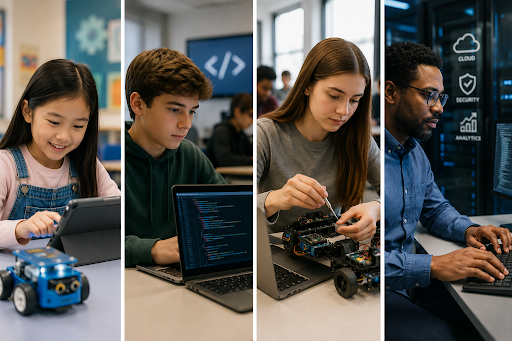
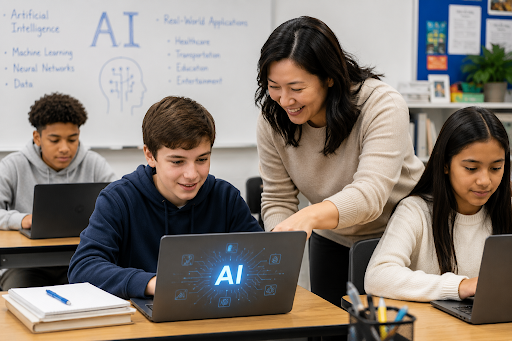
Elementary students may explore these ideas through simple examples and hands-on activities, while middle and high school students can begin connecting these concepts to real-world applications.
The goal is not to turn every student into an AI engineer. The goal is to help students understand the technology shaping their world.
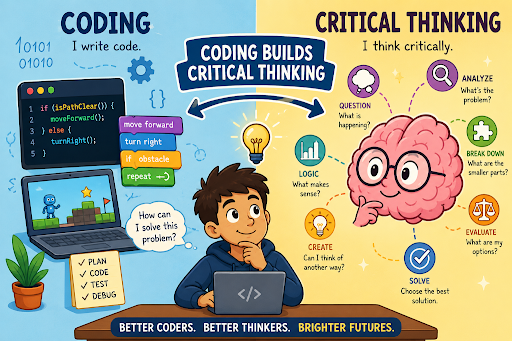
2. Critical Thinking and Verification
One of the most important AI literacy skills is skepticism.
AI tools can produce:
- Incorrect information
- Hallucinated facts
- Biased responses
- Outdated content
- Overconfident answers
Students must learn to question outputs, verify sources, compare perspectives, and recognize when AI should not be trusted without human review.
This is especially important in an era where AI-generated content can appear highly polished and convincing.
3. Ethical and Responsible Use
AI literacy also includes digital citizenship and ethics.
Students need guidance on topics such as:
- Academic integrity
- Copyright and ownership
- Bias and fairness
- Privacy and data protection
- Deepfakes and misinformation
- Responsible communication
Schools have an opportunity to teach students that AI is a tool that requires human responsibility, not a shortcut that replaces accountability.
4. Creativity and Human Skills
Ironically, the rise of AI makes human-centered skills even more important.
AI literacy should strengthen:
- Communication
- Collaboration
- Problem-solving
- Creativity
- Adaptability
- Leadership
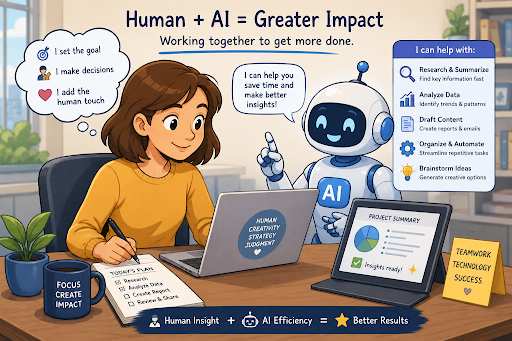
Students should learn how AI can support human work rather than replace human thinking entirely.
The future workforce will likely favor individuals who know how to combine AI tools with uniquely human strengths.
5. Career and Workforce Awareness
AI is impacting nearly every career field, not just technology jobs.
Students should understand how AI connects to:
- Healthcare
- Agriculture
- Business
- Marketing
- Cybersecurity
- Manufacturing
- Education
- Engineering
- Media and design
Career exploration helps students see AI as a cross-industry skill rather than a niche technical topic.
For K–12 schools focused on workforce development, AI literacy is rapidly becoming as essential as traditional digital literacy.
Why Prompting Alone Isn’t Enough
Prompting is only one piece of a much larger puzzle.
A student who can generate an essay with AI but cannot identify misinformation is not fully AI literate.
A student who can create AI-generated images but does not understand copyright or bias is missing critical knowledge.
A student who can automate work with AI but cannot explain the ethical implications of that automation is unprepared for the realities of modern technology use.
Prompting matters because communication matters. However, AI literacy must also include understanding, analysis, ethics, and responsible decision-making.
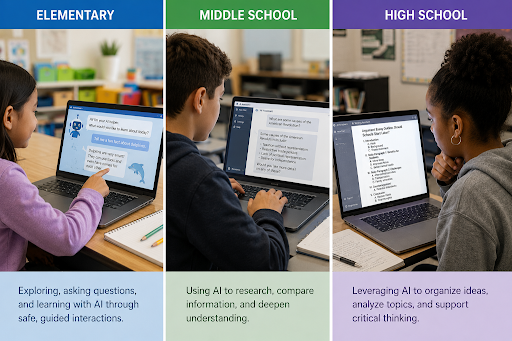
What AI Literacy Looks Like Across Grade Levels
Elementary School
At the elementary level, AI literacy may focus on:
- Understanding that AI learns from data
- Identifying AI in everyday life
- Practicing safe and responsible technology use
- Exploring creativity with guided AI tools
Middle School
Middle school students can begin:
- Evaluating AI-generated information
- Discussing ethical concerns
- Learning basic machine learning concepts
- Exploring introductory AI projects and coding
High School
High school students should move toward:
- Advanced critical analysis
- Career applications of AI
- Responsible AI workflows
- AI-assisted problem solving
- Discussions around policy, ethics, and societal impact
By graduation, students should be able to thoughtfully and responsibly engage with AI in both academic and workforce settings.
The Importance of Structured AI Education
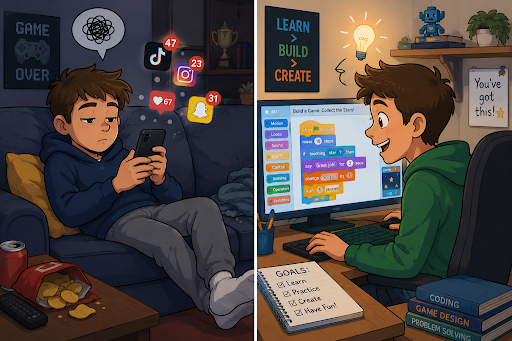
Because AI tools are evolving so quickly, many students are already experimenting with them independently. Without structured instruction, however, students may develop habits that prioritize shortcuts over learning.
This is why schools need intentional AI literacy programs that:
- Teach ethical use
- Encourage critical thinking
- Build transferable skills
- Provide age-appropriate guidance
- Connect AI learning to workforce readiness
AI literacy should not replace foundational learning. It should enhance and modernize it.
Preparing Students for an AI-Driven Future
The students entering kindergarten today will graduate into a world where AI is deeply integrated into daily life and nearly every career pathway.
Preparing them for that future requires more than teaching them how to type better prompts.
It requires teaching them:
- How AI works
- When AI should be trusted
- When human judgment matters most
- How to use AI responsibly
- How to adapt alongside emerging technologies
True AI literacy is about creating informed, ethical, adaptable learners who can confidently navigate a rapidly changing world.
And that starts in K–12 classrooms.