How to Launch a District-Wide AI Program
Artificial Intelligence (AI) is rapidly transforming nearly every industry—from healthcare and finance to agriculture and manufacturing. As these technologies become more integrated into everyday life, schools are facing a growing responsibility to prepare students for an AI-driven world.
For school districts, launching a district-wide AI program can feel overwhelming. Questions around curriculum, teacher training, infrastructure, and ethics often arise. However, with the right planning and strategy, districts can successfully introduce AI education that benefits students across all grade levels.
This guide outlines practical steps districts can take to launch and sustain a successful AI program across multiple schools.
Why Districts Are Investing in AI Education
AI is no longer a niche topic reserved for advanced college courses. Today, students need to understand how AI works, how it impacts society, and how to use it responsibly.
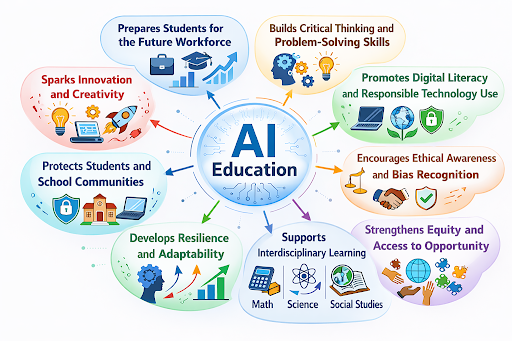
A district-wide AI initiative helps schools:
- Prepare students for future careers in technology and beyond
- Build critical thinking and problem-solving skills
- Strengthen digital literacy and responsible technology use
- Promote ethical awareness around algorithms and bias
- Provide equitable access to emerging technologies
By introducing AI education early, districts ensure that all students—not just those in specialized programs—have exposure to one of the most influential technologies of the modern era.
Step 1: Define Your District’s Goals for AI Education
Before selecting tools or curriculum, districts should determine what they want students to gain from AI education.
Questions to consider include:
- Are we introducing AI literacy for all students, or creating career pathways in AI and data science?
- Should AI be taught as a standalone course or integrated into existing subjects?
- Which grade levels will participate?
Many districts choose a tiered approach, introducing foundational AI concepts in elementary school and expanding into applied AI and certification opportunities in high school.
Clear goals help guide decisions about curriculum, staffing, and long-term investment.
Step 2: Select an Age-Appropriate AI Curriculum
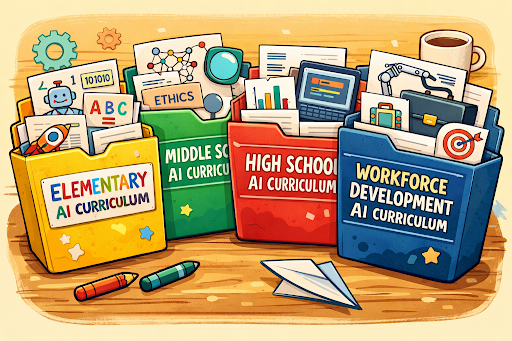
AI education should be scaffolded across grade levels so students gradually build understanding.
A strong district-wide curriculum typically includes:
Elementary School
Students are introduced to foundational concepts such as:
- What AI is and where it appears in daily life
- Pattern recognition and simple machine learning ideas
- Responsible technology use
Lessons are often hands-on and project-based, helping younger learners connect abstract concepts to real-world examples.
Middle School
Students begin exploring AI more deeply through activities such as:
- Training simple AI models
- Understanding data and algorithms
- Exploring bias and ethical implications
This stage builds foundational skills while maintaining strong engagement.
High School
High school courses may include:
- AI prompt engineering
- Machine learning fundamentals
- AI-powered applications and tools
- Workforce certifications or career pathways
At this level, students can begin applying AI to real-world challenges, preparing them for college programs or industry roles.
Step 3: Provide Teacher Training and Professional Development
One of the biggest barriers to implementing AI education is teacher confidence. Many educators feel unsure about teaching emerging technologies.
Districts can overcome this challenge by offering structured professional development programs, including:
- AI fundamentals training for educators
- Classroom implementation strategies
- Ethical considerations and responsible AI use
- Ongoing coaching and support
When teachers feel supported, they are far more likely to successfully integrate AI into their classrooms.
Step 4: Ensure Technology Infrastructure Is Ready
AI programs require reliable technology infrastructure. Districts should review whether their current systems support:
- Cloud-based learning platforms
- Interactive AI tools and simulations
- Secure student access to AI software
- Device compatibility across classrooms
Most modern AI education platforms are browser-based, which allows districts to launch programs without major hardware upgrades.
However, ensuring strong connectivity and device access remains critical for success.
Step 5: Prioritize Ethical AI and Digital Responsibility
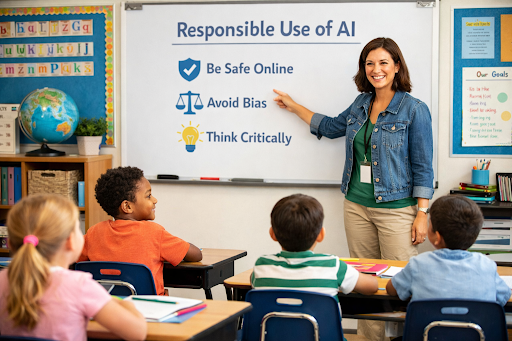
AI education should not only focus on technical skills. Students must also learn to think critically about how AI affects society.
District-wide programs should include discussions on:
- Algorithmic bias
- Data privacy
- Responsible AI usage
- Misinformation and deepfakes
- The societal impact of automation
Teaching these topics helps students become informed and responsible technology users, not just consumers of AI tools.
Step 6: Start with Pilot Programs Before Scaling
Launching across an entire district at once can be challenging. Many districts start with a pilot program in a few schools or grade levels before expanding.
Pilot programs allow districts to:
- Gather teacher and student feedback
- Refine lesson pacing and materials
- Identify technical challenges
- Build internal champions who can support expansion
Once the pilot proves successful, districts can scale the program more confidently.
Step 7: Track Data and Measure Impact
To sustain long-term support, districts should measure the outcomes of their AI programs.
Important metrics may include:
- Student engagement and participation
- Course completion rates
- Skill development and assessment data
- Student interest in technology careers
- Teacher adoption and feedback
Data-driven insights help districts continuously improve their programs and demonstrate value to stakeholders.
Building the Future of AI Education
Launching a district-wide AI program is a significant undertaking, but it represents one of the most important investments schools can make for the future.
By providing structured curriculum, strong teacher support, and ethical guidance, districts can empower students to understand and shape the technologies that will define the next generation.
AI education is not just about teaching students how to use tools—it is about helping them think critically, innovate responsibly, and prepare for a rapidly evolving workforce.
School districts that begin this journey today will be better positioned to equip students with the knowledge and skills needed for the future of work.