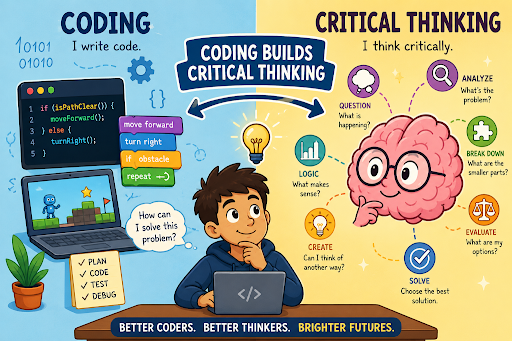
Building Critical Thinking Through Coding
When most people think about coding, they picture students learning programming languages, building websites, or creating games. While those technical skills are valuable, coding offers something even more important: the opportunity to develop critical thinking skills that students can apply throughout their lives.
In today’s world, employers consistently rank problem-solving, adaptability, and analytical thinking among the most important skills for future success. Coding provides a natural and engaging way for students to practice these skills while creating projects they enjoy.
Coding Is More Than Writing Code
At its core, coding is about solving problems.
Whether a student is creating a simple animation, designing a video game, or building a website, they are constantly making decisions and evaluating outcomes. They must think through challenges, test ideas, identify mistakes, and improve their work.
This process mirrors the same critical thinking skills used by engineers, business leaders, healthcare professionals, and countless other careers.
Students quickly learn that there is rarely just one correct solution. Instead, they explore multiple approaches, compare results, and determine which option works best.
Learning to Break Down Complex Problems
One of the first skills students develop through coding is decomposition, or breaking large problems into smaller, manageable pieces.
Imagine a student wants to create a game where a character moves through a maze, collects points, and avoids obstacles. At first, the project may seem overwhelming.
Through coding, students learn to ask questions such as:
- How will the character move?
- How will points be collected?
- What happens when the player hits an obstacle?
- How will the game keep score?
By breaking a large challenge into smaller tasks, students develop a structured approach to problem-solving that can be applied in school, work, and everyday life.
Developing Persistence and Resilience
Coding teaches students that mistakes are not failures. They are opportunities to learn.
Even experienced programmers encounter errors and unexpected results. Students quickly discover that debugging is simply part of the process.
When something doesn’t work as expected, students learn to:
- Analyze the problem
- Test possible solutions
- Gather evidence
- Make adjustments
- Try again
This cycle builds perseverance and resilience. Instead of giving up when faced with a challenge, students develop confidence in their ability to work through obstacles and find solutions.
Encouraging Creativity and Innovation
Critical thinking is not only about analyzing information. It also involves creating new ideas and innovative solutions.
Coding allows students to transform their ideas into reality. They can design games, build apps, create animations, or develop solutions to real-world problems.
As they work, students must evaluate choices, predict outcomes, and make design decisions. Every project becomes an exercise in both creativity and logical reasoning.
The combination of creative thinking and analytical thinking is a powerful skill set that prepares students for a wide range of future opportunities.
Building Real-World Decision-Making Skills
Coding projects often require students to make decisions with limited information.
Should a game use one design or another? Which solution is more efficient? How can a user experience be improved?
These questions encourage students to evaluate evidence, weigh trade-offs, and justify their decisions.
Over time, students become more comfortable making thoughtful choices and explaining their reasoning, skills that are valuable in academic settings, careers, and daily life.
Preparing Students for an AI-Driven Future
As artificial intelligence and technology continue to reshape industries, critical thinking is becoming more important than ever.
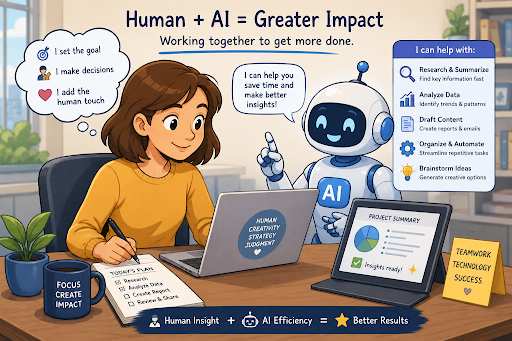
While technology can automate certain tasks, it cannot replace human judgment, creativity, ethical decision-making, and complex problem-solving.
Coding helps students build these uniquely human skills while also developing an understanding of the technologies shaping the future. Students learn not only how technology works, but also how to think critically about its uses, limitations, and impact.
The Lasting Value of Coding Education
Not every student who learns coding will become a software developer. That is perfectly okay.
The true value of coding extends far beyond computer science careers. Through coding, students learn how to analyze problems, think logically, collaborate with others, and persist through challenges.
These are skills that benefit future engineers, healthcare professionals, business leaders, educators, entrepreneurs, and countless other professions.
When students learn to code, they are not just learning technology. They are developing the critical thinking skills that will help them succeed in whatever path they choose.