Preparing Students for an AI-Augmented Workforce
Artificial intelligence is no longer a technology reserved for software engineers or data scientists. It is quickly becoming part of everyday work across nearly every industry. From healthcare and manufacturing to marketing, education, finance, and skilled trades, AI is changing how people solve problems, make decisions, and complete routine tasks.
This doesn’t mean AI will replace the workforce. Instead, it means the workforce is changing. The employees who thrive will be those who know how to work alongside AI while applying the uniquely human skills that technology cannot replicate.
Preparing students for this AI-augmented workforce begins long before they enter college or apply for their first job.
What Does “AI-Augmented” Mean?
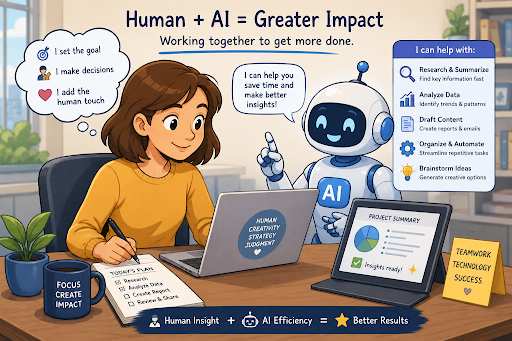
An AI-augmented workforce is one where people use artificial intelligence to improve their work rather than replace it.
Instead of spending hours on repetitive tasks, professionals can use AI to:
- Draft reports and emails
- Analyze large amounts of information
- Generate ideas and brainstorm solutions
- Automate repetitive processes
- Summarize research
- Create visual content
- Support decision-making
The human remains responsible for evaluating, refining, and applying these outputs. AI becomes a powerful assistant, not an independent worker.
The Skills Employers Are Looking For
As AI becomes more capable, employers are placing even greater value on human-centered skills.
Students entering tomorrow’s workforce will need to demonstrate:
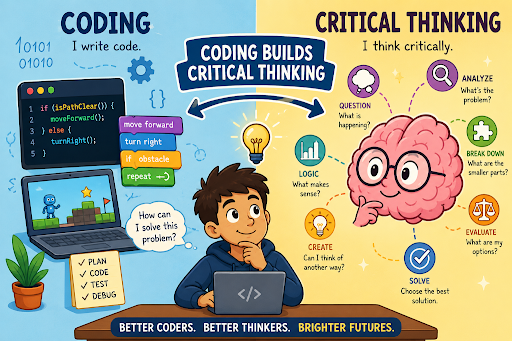
Critical Thinking
AI can generate answers quickly, but it cannot guarantee they are correct.
Students must learn to:
- Verify information
- Identify inaccuracies
- Evaluate evidence
- Compare multiple perspectives
- Make informed decisions
Knowing when not to trust AI is becoming just as important as knowing how to use it.
Communication
Whether collaborating with teammates or creating effective AI prompts, communication remains essential.
Students should practice:
- Asking clear questions
- Explaining complex ideas
- Presenting information effectively
- Writing with purpose
- Giving and receiving feedback
Clear communication improves both human collaboration and AI interactions.
Creativity
AI can assist with brainstorming, but original ideas still come from people.
Students need opportunities to:
- Design solutions
- Build original projects
- Experiment with new approaches
- Think beyond obvious answers
- Combine ideas in innovative ways
Creativity becomes even more valuable when AI handles routine production tasks.
Ethical Decision Making
As AI becomes more integrated into society, ethical questions continue to grow.
Students should understand topics such as:
- Bias in AI systems
- Responsible AI use
- Privacy and security
- Intellectual property
- Transparency
- Digital citizenship
Responsible technology users become responsible technology leaders.
Adaptability
Technology evolves rapidly.
The tools students use today may look completely different in five years.
Rather than memorizing one platform, students should develop the confidence to:
- Learn new technologies
- Experiment with unfamiliar tools
- Solve unfamiliar problems
- Continue learning throughout their careers
Adaptability is one of the most future-proof skills students can develop.
AI Literacy Should Be a Core Skill
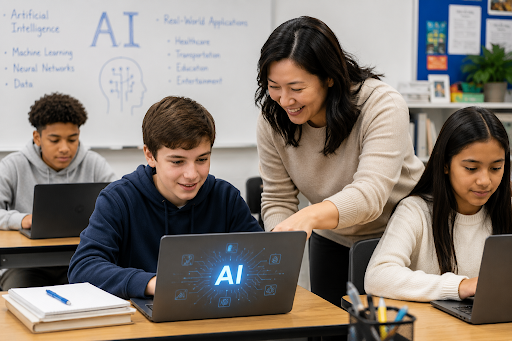
Just as schools teach digital literacy, financial literacy, and media literacy, AI literacy is becoming an essential component of modern education.
Students should understand:
- What AI is and how it works
- Where AI is commonly used
- Its strengths and limitations
- How to write effective prompts
- How to verify AI-generated content
- The ethical responsibilities of using AI
AI literacy empowers students to use technology thoughtfully instead of simply consuming it.
Learning by Doing
Students gain the deepest understanding when they actively use AI to solve authentic problems.
Hands-on learning experiences might include:
- Creating presentations with AI support
- Comparing AI-generated content with human work
- Designing chatbots or simple AI-powered applications
- Evaluating AI-generated images or videos
- Using AI to assist with research projects
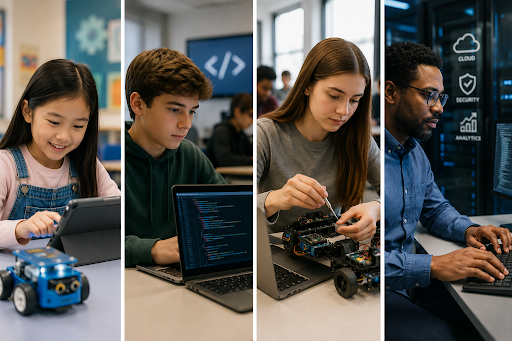
- Completing collaborative design challenges
These experiences help students move beyond simply using AI tools to understanding how and when they should be used.
Every Career Will Be Influenced by AI
Students often assume AI only affects technology careers, but its impact reaches nearly every profession.
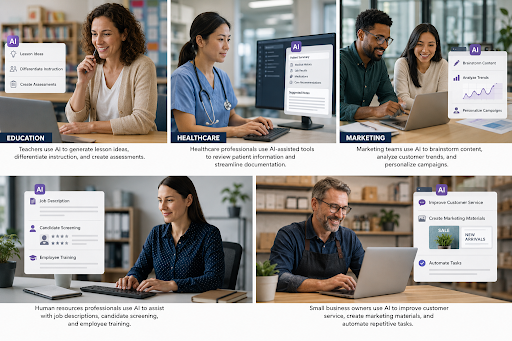
Healthcare professionals use AI to analyze patient information and streamline documentation.
Teachers use AI to personalize instruction and generate classroom resources.
Manufacturers use AI for predictive maintenance and quality control.
Marketing professionals analyze customer trends and generate campaign ideas with AI assistance.
Financial analysts use AI to identify patterns and improve forecasting.
Even skilled trades are beginning to incorporate AI into diagnostics, planning, and equipment management.
Helping students recognize these connections allows them to see AI as a workplace tool rather than a standalone subject.
Schools Have an Opportunity Today
Preparing students for the future isn’t about teaching them to rely on artificial intelligence. It’s about teaching them how to use it responsibly, critically, and effectively.
Schools that introduce AI concepts alongside problem solving, collaboration, creativity, and ethical decision making are helping students build the confidence they’ll need regardless of which career path they choose.
The workforce of tomorrow will reward individuals who can combine human judgment with AI capabilities. By developing AI literacy today, educators are preparing students not just to participate in the future of work, but to lead it.
Final Thoughts
Artificial intelligence is reshaping industries at an unprecedented pace, but the most successful professionals will always bring something AI cannot: human insight, empathy, creativity, and sound judgment.
By giving students opportunities to explore AI in meaningful, responsible, and hands-on ways, schools can prepare graduates who are ready to thrive in an AI-augmented workforce. The goal isn’t simply to teach students about artificial intelligence. It’s to help them become adaptable, thoughtful, and lifelong learners who can confidently navigate whatever technologies the future holds.