The ROI of Certification-Aligned Curriculum
School leaders today are being asked to do more with less while still preparing students for a rapidly evolving workforce. Computer science, AI, and cybersecurity programs are no longer “nice to have.” They are essential. But with tight budgets and competing priorities, every investment must clearly demonstrate value.
That’s where certification-aligned curriculum stands out.
Rather than teaching isolated concepts, certification-aligned programs connect learning directly to industry-recognized credentials. The result is a measurable return on investment that impacts students, schools, and long-term program sustainability.
What Does “Certification-Aligned” Actually Mean?
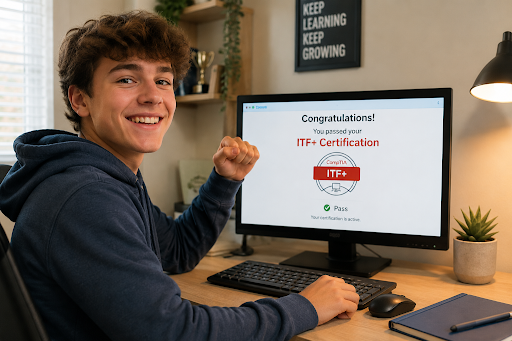
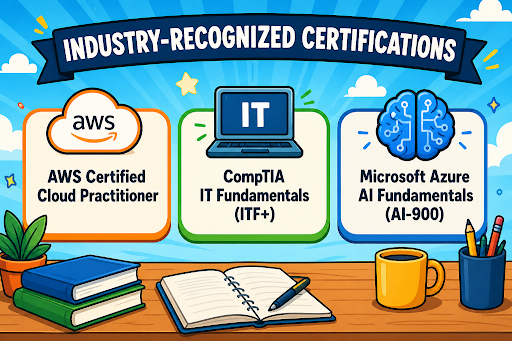
Certification-aligned curriculum is intentionally designed to prepare students for real-world, industry-recognized certifications such as AWS Certified Cloud Practitioner, CompTIA IT Fundamentals (ITF+), or Microsoft Azure AI Fundamentals (AI-900).
This alignment ensures that:
- Skills taught are relevant and up to date
- Learning outcomes are measurable
- Students are building toward a tangible goal
Instead of “learning about technology,” students are actively preparing for credentials that signal readiness to colleges and employers.
1. Measurable Student Outcomes
One of the biggest challenges in education is proving impact. Certification-aligned curriculum solves this by creating clear benchmarks for success.
Students are not just completing assignments. They are working toward passing a recognized certification exam. That creates:
- Defined skill mastery
- Objective performance data
- A clear end goal for both students and educators
Even when students do not sit for the exam, alignment ensures they are gaining the exact knowledge and competencies required in the field.
2. Stronger Workforce Readiness
The connection between certification and career readiness is direct.
When students engage with certification-aligned content, they are:
- Learning industry tools and terminology
- Practicing real-world scenarios
- Building confidence in technical environments
For example, a student studying cloud computing aligned to AWS standards is not just learning theory. They are understanding how cloud infrastructure works in real businesses.
This bridges one of the biggest gaps in education: the transition from classroom learning to workforce application.
3. Increased Program Value for Schools
From a school or district perspective, certification alignment strengthens the value proposition of any computer science program.
It allows schools to:
- Demonstrate career readiness outcomes to stakeholders
- Align with CTE pathways and workforce development goals
- Support grant applications with clear, outcome-based metrics
When administrators can point to certification pathways, the program becomes easier to justify in budget conversations and strategic planning.
4. Higher Student Engagement and Motivation
Students are more motivated when their work has a clear, real-world purpose.
Certification-aligned curriculum naturally increases engagement because:
- Students understand the “why” behind what they are learning
- Progress feels meaningful and goal-oriented
- Achievements can be shared beyond the classroom
Earning or preparing for a certification gives students something tangible to show for their effort, which increases both persistence and pride in their work.
5. Long-Term Return: Beyond the Classroom
The ROI of certification-aligned curriculum does not stop at course completion.
Students walk away with:
- Resume-building credentials
- College and career advantages
- A clearer understanding of potential career paths
For schools, this translates into:
- Stronger program reputation
- Increased enrollment in tech pathways
- Better alignment with workforce needs
It’s a long-term investment that continues to pay dividends well after the course ends.
A Practical Consideration: Access vs. Alignment
It is important to note that certification alignment does not always require full access to paid platforms or environments.
Strong programs balance:
- Conceptual understanding
- Guided practice
- Strategic exposure to tools and environments
This approach minimizes risk and cost while still delivering meaningful preparation. Schools can provide high-quality, certification-aligned learning experiences without taking on unnecessary financial or operational burden.
Final Thoughts
Certification-aligned curriculum is not just about passing an exam. It is about aligning education with real-world expectations, creating measurable outcomes, and preparing students for what comes next.
For schools evaluating where to invest, the question is no longer whether computer science matters. It is how to ensure that investment leads to tangible results.
Certification alignment is one of the clearest ways to do exactly that.
If you are exploring how to implement certification-aligned pathways in your program, the right partner and structure can make all the difference. Schedule your FREE Rex demo here: https://www.rexk12.com/rex-demo/.